

The WAVE is over. The photographs have been posted, the hugs exchanged, the speeches delivered. For a weekend, Life Chiropractic College West could look almost normal again, an institution surrounded by alumni, speakers and friends who clearly want it to survive.
Wanting Life West to survive is not the problem.
The problem is the growing tendency to confuse support for the institution with support for the people whose conduct placed it in jeopardy. The distinction should be elementary. Somehow, in chiropractic, it has become controversial.
There is now too much evidence to dismiss what is happening at Life West as rumor, politics or the work of disgruntled outsiders. WSCUC placed the college on probation after identifying serious deficiencies involving governance, financial sustainability, conflicts of interest and institutional integrity.
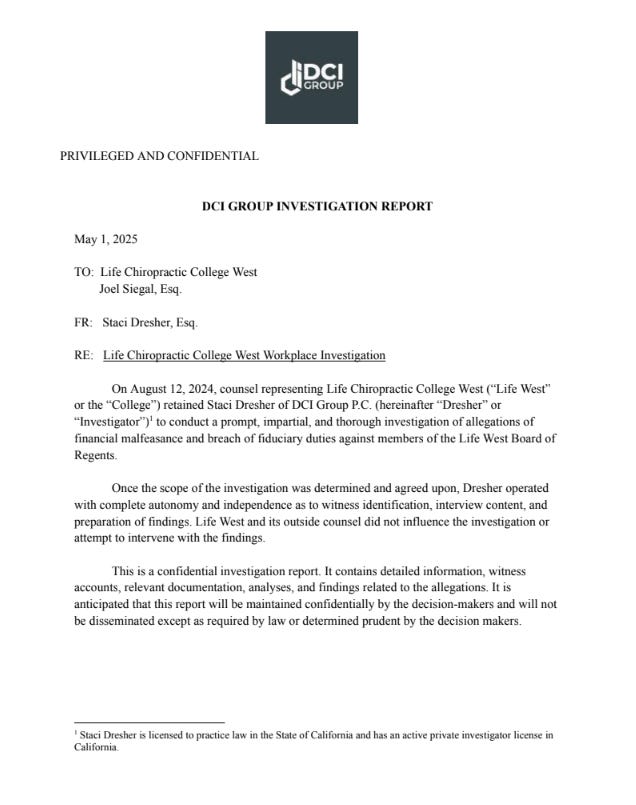
Life West’s own attorneys commissioned an independent investigation into allegations of financial malfeasance and breaches of fiduciary duty by members of its Board of Regents. Investigator Staci Dresher reported that she operated independently, without interference from Life West or its outside counsel, and ultimately sustained core allegations involving the Board’s leadership.
The same $20 million Arizona property that became central to the accreditor’s concerns was also central to the college’s internal investigation. Life West’s own investigator and WSCUC independently reached similar conclusions about failures to follow conflict-of-interest rules surrounding the transaction. The building is now vacant and being marketed for lease or sale, while the college continues carrying the associated debt and costs.

Then the sexual assault case surfaced.
Six former students have sued Life West and former professor Cedric Stewart, D.C., alleging sexual assault, harassment and institutional failures under Title IX. The allegations have not been adjudicated, and Life West and Stewart deny liability. But the complaint contains detailed allegations that multiple students reported Stewart to multiple Life West officials beginning in February 2023. One student alleges Life West’s Civil Rights Investigator acknowledged awareness of other complaints. Another says Dean of Academics and Compliance Adam Thompson promised an investigation and then never followed up. C.P. alleges that after telling Thompson she did not feel safe with Stewart on campus, he told her there was “nothing LIFE WEST could do.”

These are not internet rumors. They are allegations in a filed lawsuit. And they sit beside accreditation findings and an independent investigation commissioned by the college itself. At some point, people have to decide what they are defending.
Stephanie Libs Said It From the WAVE Stage
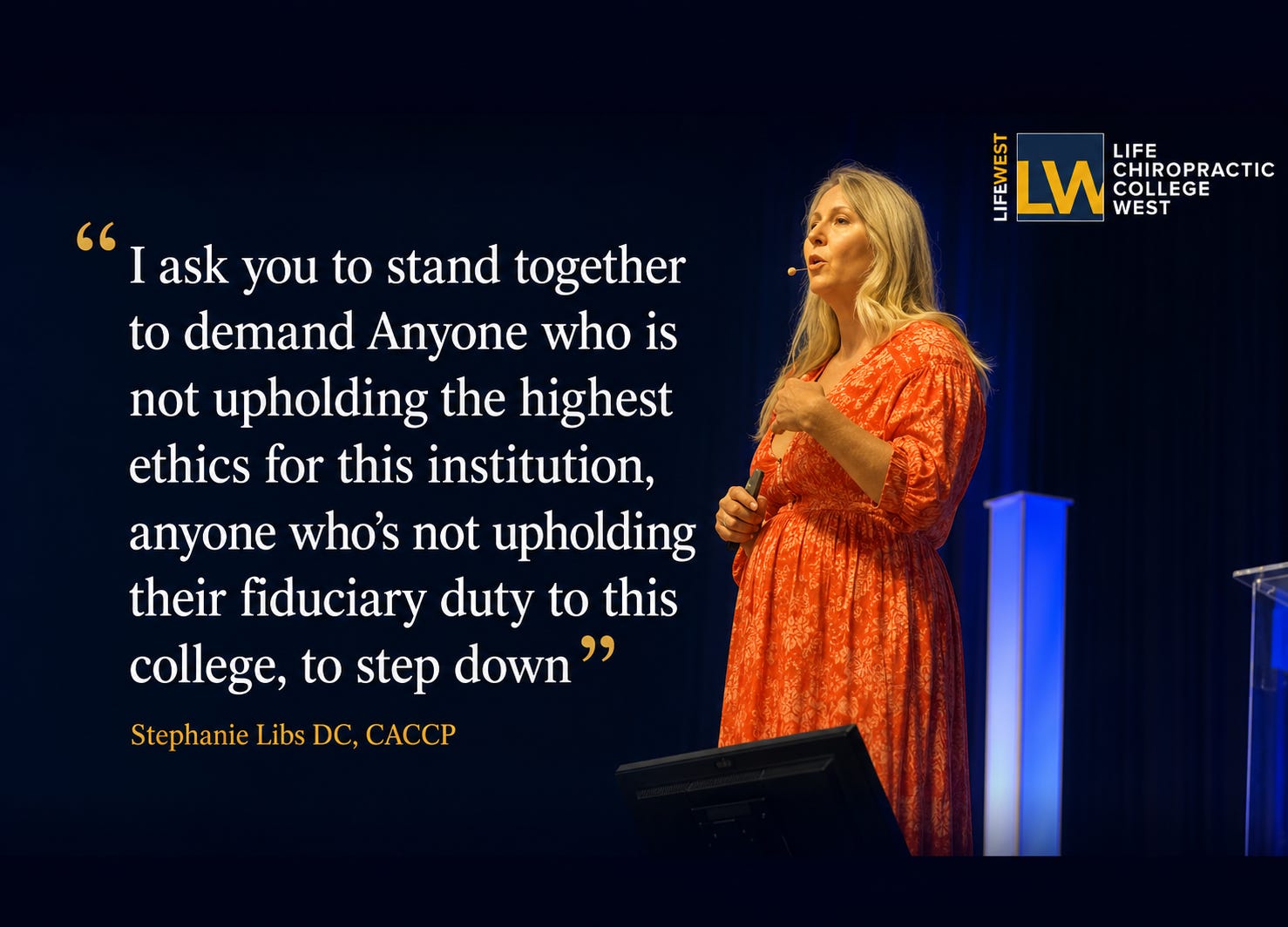
One of the more meaningful moments of the entire weekend came from Life West alum Stephanie Libs, D.C., CACCP, precisely because she refused to accept the false choice between loving the college and confronting what has happened to it.
Her statement should be read in full:
“I will sell chiropractic, serve chiropractic, and save chiropractic if it will take me 20 lifetimes to do it. I will promote it within the law, without the law, in keeping with the law or against the law. Now I know this weekend has been a little different. I know there are lots of wild rumors going around.
So I would just like to set the record straight. Don’t walk out on this place. Don’t walk out. Walk in. Stand up and deserve better. And I ask you to stand together to demand Anyone who is not upholding the highest ethics for this institution, anyone who’s not upholding their fiduciary duty to this college, to step down.
Step down, get out of the way. Because the truth finds a way. Before I came onto this stage, my mother-in-law said to me, you can lead with love or you can lead with anger. I lead with love, but I’m a little bit angry. So, the truth finds a way. Always. Life finds a way.
Life West will find a way.”
There is more wisdom in that statement than in a hundred social media testimonials about what a great guy someone is.
Libs did not tell people to abandon Life West. She told them to stop confusing the school with the people temporarily entrusted to govern it. That difference matters. Institutions endure only when leadership understands that holding office is conditional, that fiduciary duty is an obligation rather than an honorific, and that no individual is indispensable enough to justify sacrificing the organization around him.
Instead, what we keep seeing throughout chiropractic is something closer to tribal protection.
A person comes under scrutiny, friends assemble. Someone publishes documents, friends attack the messenger. An accreditor reaches an adverse conclusion, allies insist there must be another explanation. A board’s own investigator sustains allegations, supporters debate who leaked the report rather than what the report found.
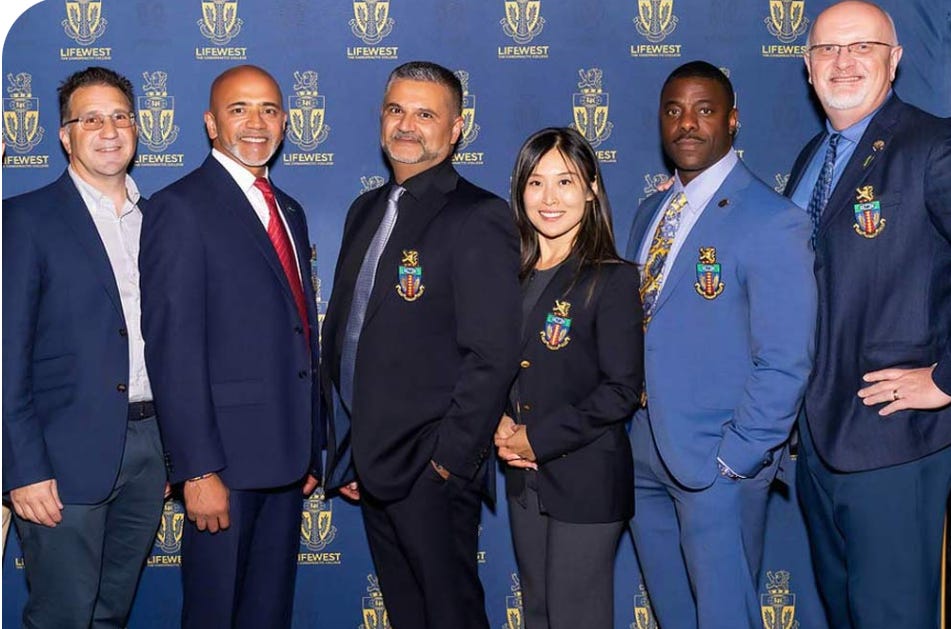
Then everyone takes a group picture.
That is not governance.
It is adolescent loyalty masquerading as institutional stewardship.
There Comes a Point When “Rumor” Becomes Denial
The reflexive defense of Life West’s leadership would be merely tiresome if the stakes were not so high.
Its own independent investigator examined allegations against Board Chair Amit “Jimmy” Nanda and Regent Niraj Patel after whistleblower complaints were filed with WSCUC by then-President Ronald Oberstein and former Regent Scott Turner. The investigation was not commissioned by this publication. It was commissioned by counsel for Life West. Dresher states expressly that she exercised autonomy over witnesses, interviews and findings.
Nanda, Patel, Steven Silk, Edward Sordillo and Cameron Hastings were asked repeatedly to participate in formal interviews. According to the report, the investigator received no response to those requests. Nanda participated only in a brief later conversation with attorney Natasha Baker, during which they told Dresher the Board had not authorized the investigation.
That is their right. People are not obligated to cooperate with every investigator who seeks to interview them. But declining to participate does not make the resulting documentary record disappear, and it certainly does not transform sustained findings into gossip.
WSCUC then conducted its own review and it found governance failures independently.
This is why the social defense mounted around particular individuals has become so difficult to take seriously. We are no longer looking at one accuser, one journalist or one disgruntled former employee. We are looking at overlapping evidence from an institutional accreditor, an investigator retained by the college, financial records, internal communications and court filings.
The rational response to that record is scrutiny.
The chiropractic response, apparently, is a drunken reunion photo.
The Sexual Assault Case Should Have Changed the Tone Immediately
Whatever appetite anyone had for personality politics should have ended when the allegations of six former students became public.
The plaintiffs allege that they reported sexual misconduct involving Cedric Stewart to Life West officials beginning in February 2023. Their complaint describes reports moving through people with institutional responsibility, including a Civil Rights Investigator, Title IX personnel, the Dean of Academics and Compliance and Vice President of Clinical Operations Scott Donaldson. The students allege that Stewart nevertheless remained on campus and continued to occupy visible roles associated with the college.
K.S. alleges that Civil Rights Investigator Jeana Edwards indicated awareness of other complaints involving Stewart.
M.A. alleges that Adam Thompson initially appeared sympathetic, promised an investigation and an update, then never contacted her again.
C.P. alleges that she told Thompson she did not feel safe with Stewart on campus and was told:
“There was nothing LIFE WEST could do.”
What should not be difficult to understand is that friendship with an accused professor does not rebut a student’s testimony, just as friendship or brotherhood with a Board chair does not rebut an accreditor’s findings. Character testimonials may tell us that someone has been kind, generous or inspiring to the person offering the testimonial. They do not establish what happened in another room, at another meeting, in a financial transaction or after a student filed a complaint.
That is why evidence exists.
The willingness of some people to leap from “he is my brother” to “therefore this cannot be true” is not merely intellectually lazy. When the subject is alleged sexual misconduct involving students, it becomes grotesque.
The proper response is neither a presumption of guilt nor a presumption that the women must be lying.
It is to investigate.
That should not be revolutionary.
Life University’s Crisis Is Different, but the Disease Looks Familiar
Anyone tempted to regard Life West as an unfortunate exception should look east.
Life University is experiencing its own slow-moving institutional crisis, one built less around a single event than around years of governance entrenchment, financial deterioration, accreditation pressure and leadership instability.
Its audited financials and bond covenant reports are particularly difficult to dismiss because numbers are stubborn things.
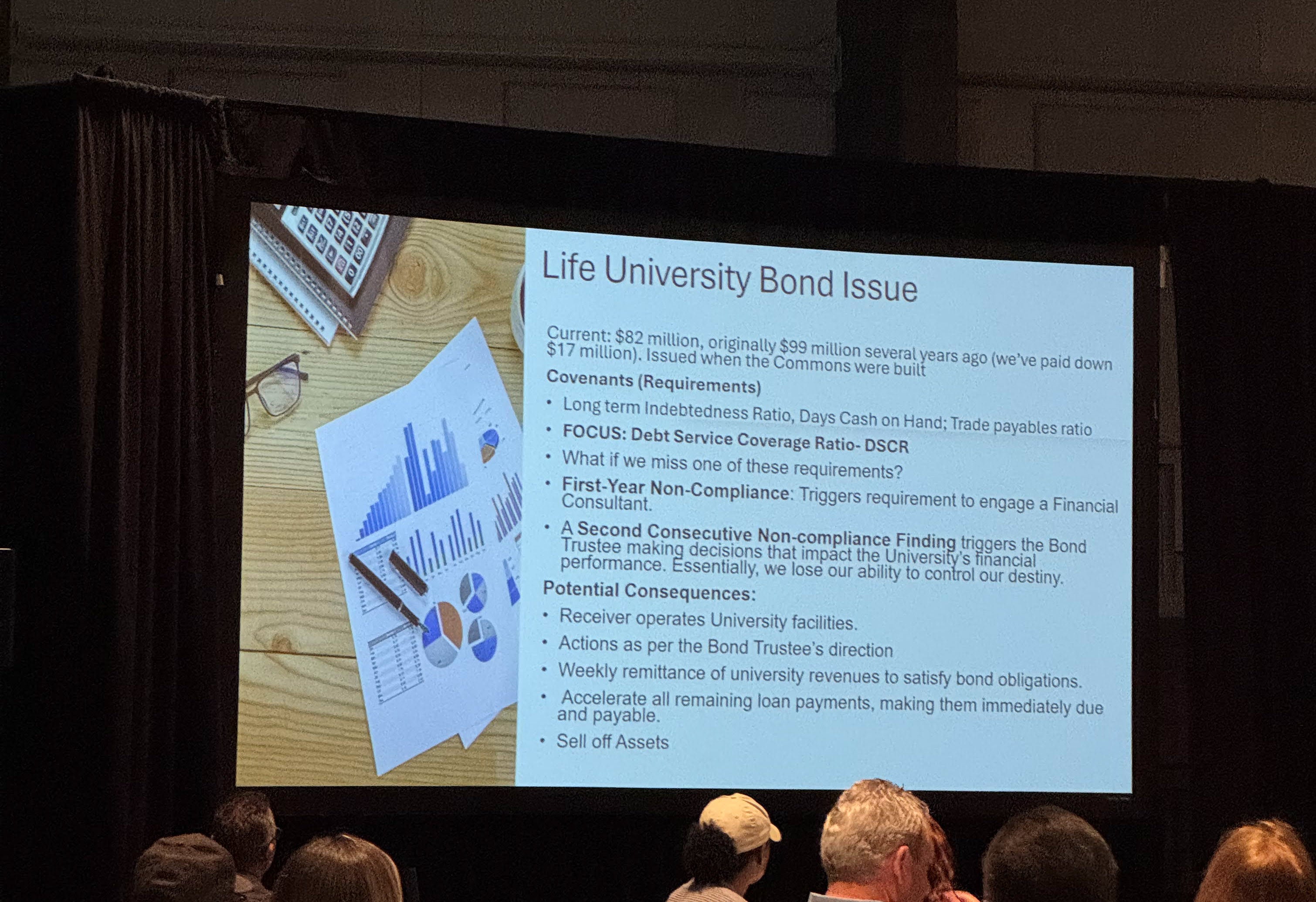
For fiscal 2025, Life University reported $78.8 million in operating revenue against $81.9 million in operating expenses, an operating deficit of roughly $3.1 million. Its annual debt service coverage ratio still cleared the required covenant at 1.45, but the subsequent interim numbers deteriorated sharply. The September 2025 quarterly calculation produced a negative 0.19 ratio. At December, the year-to-date figure was 0.86. By March 2026 it was 0.69, again below the 1.20 covenant requirement. At the nine-month mark, operating revenue had fallen by approximately $6.1 million year over year while expenses barely moved.
That is not an ideological argument. It just basic arithmetic.
Life University is carrying the legacy of a 2017 refinancing that loaded the institution with close to $100 million in debt, while its revenue base is weakening and its cost structure has not contracted proportionately. The same investigative brief documents undergraduate retention at 65 percent for the 2024 to 2025 academic year, another number that deserves far more attention than it has received.
Yet the governance structure responsible for navigating these pressures remains deeply connected to the institutional network built during the Guy Riekeman era.
Life University’s own 2017 bond disclosure described Life Strategic Accelerator, LLC, an entity organized as a business incubator and wholly owned by the university. Riekeman, while serving as Chancellor, was also the manager responsible for identifying, negotiating and structuring the affiliate’s strategic opportunities. Its investment committee included senior university leadership and members of the same Board responsible for institutional oversight.
The point is that this kind of structure concentrates influence precisely where independent institutional oversight should be strongest. When an institution later encounters serious financial and leadership problems, the history of who controlled what becomes relevant.
Very relevant.
Changing the Chair Is Not the Same as Changing the System
Life University’s recent Board churn has produced plenty of titles without much evidence yet of structural reform.
Kevin Fogarty resigned as Board Chair effective March 31, 2026. Aaron Gagnon was announced as the new chair beginning April 1, while Fogarty apparently remained on the Board. Salvatore LaRusso, a former NBCE president, was also added as a trustee. Subsequent reporting identifies Sandra Elbaum, D.C., as Board Chairman and Fogarty as Chairman Emeritus, creating yet another leadership transition whose chronology remains incompletely explained in institutional communications.
Changing the name on the chair’s office does not necessarily change the governing culture. Reports from inside the institution point to Fogarty as pulling Elbaum’s strings and still running the show.
The university has also moved through consecutive interim presidents. Brian McAulay, himself a figure from the Riekeman-era administration, served as interim president and became the public face of the policy requiring students to pass NBCE examinations before graduation. Lee Skinkle, Ph.D., is now serving as interim president while the institution says its permanent presidential search is in its final stages.
At some point a university needs something more than succession.
It needs reform.
If the same networks select the replacements, govern the replacements, control nominations and preserve the underlying structure, leadership change can become little more than institutional theater.
Life West should be paying attention to that lesson and Life University should be paying attention to Life West’s.
The NBCE Solution Is Becoming the Default Institutional Escape Hatch
There is an uncomfortable symmetry between the two schools.
Both have responded to accreditation pressures involving NBCE performance by embedding a private examination corporation more deeply into their academic programs.
At Life University, students beginning in Fall 2025 cannot graduate without passing all four parts of the NBCE examinations. The policy was introduced after the chiropractic program had been placed on CCE probation over Policy 56 performance. CCE subsequently removed the probation after Life met the required threshold. The structural problem is obvious, Policy 56 measures passage within six months after graduation, while Life now prevents students from graduating until the exams have already been passed.
That may improve the reported metric.
It does not necessarily tell us whether the underlying education improved.
Life West has moved in a related direction, tying progression through its clinical curriculum to NBCE passage.
The result is a remarkable transfer of academic authority. Two institutions under stress have effectively given a private testing organization increasing power over when their students progress or graduate.
Life University’s AS.067 policy raises an additional concern because the investigative record indicates that the new graduation condition was applied to already-enrolled students, with an exception written around current licensure that no enrolled chiropractic student could logically possess. Complaints concerning that retroactive application have been lodged with accreditation and state authorities.
This is what institutional weakness looks like when viewed from the student’s side.
The school struggles with a regulatory metric.
The student inherits the solution.
And Life University Has Its Own Litigation Problem
The parallels do not end with accreditation.
Life University is defending multiple federal employment actions in the Northern District of Georgia. Three complaints were filed on December 22, 2023, against Life University asserting claims including race discrimination and retaliation under Title VII and 42 U.S.C. § 1981. Another 2024 action includes claims of age discrimination retaliation and False Claims Act retaliation. A 2026 multi-plaintiff action alleges § 1981 retaliation.
The False Claims Act retaliation complaint is particularly serious. According to the filing, the plaintiff alleges that after being placed on administrative leave over a Medicare fraud concern and later cleared internally, he reported that Dean Clusserath had participated in covering up improper Medicare billing, including altering the characterization of services and deleting records.
For God’s sake, do not pretend that a stack of complaints involving recurring themes is meaningless merely because none has yet reached a final judgment.
Institutions with healthy governance investigate patterns before outsiders force them to. Institutions in denial explain every incident away separately until the pattern is impossible to ignore.
Even the Bourbon Story Tells You Something About Governance
Life University also has a bizarre but revealing episode involving Maker’s Mark bourbon.
On its face, the amount involved is small compared with the university’s debt. That is why the real importance of the story is not the liquor.
It is what the government’s own internal notes show about institutional judgment.
In February 2025, outside counsel Michele Stumpe contacted the Georgia Department of Revenue Alcohol and Tobacco Division concerning bottles of Maker’s Mark. Her account was that alcohol had been given away, not sold, that the client wanted to verify previous advice, that the conduct had stopped and that the client was prepared to self-disclose, potentially pay taxes and destroy the alcohol.
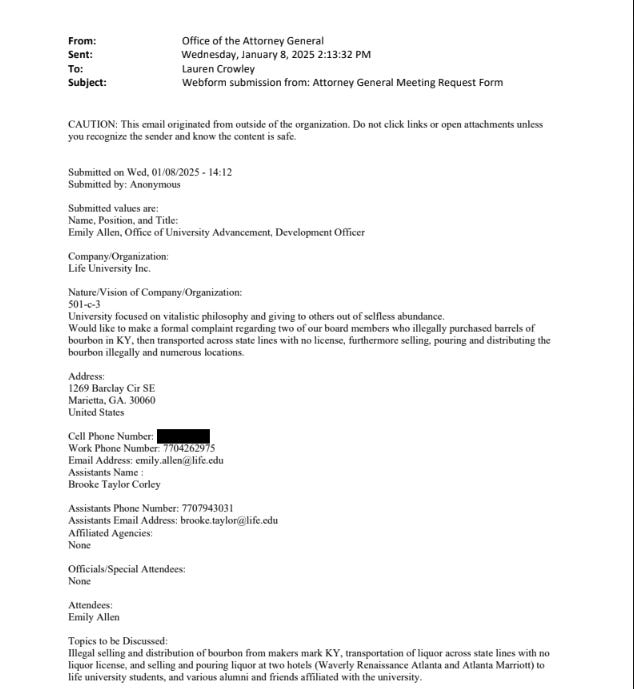
Despite the whistleblower, Georgia DOR’s internal notes characterized the matter as self-reporting, discussed untaxed liquor shipped directly from Kentucky to Georgia, noted that Georgia did not permit direct-to-consumer liquor shipping under the circumstances described and cited O.C.G.A. § 3-3-8, dealing with possession of alcoholic beverages upon which taxes have not been paid. The agency discussed destruction of the product and whether an agent should witness it. One internal note from managing attorney Matthew Cristy recorded his feeling that the agency did not yet have the full story.
There is an important evidentiary gap here. The available record does not establish how the matter was ultimately resolved or why. Who made it go away?
That gap should be respected.
But the episode illustrates the wider point. When an institution already faces governance and financial questions, seemingly minor episodes involving compliance stop looking minor. They become tests of whether the organization possesses the habits of transparency and control expected of a university receiving public support and federal student aid.
The Profession Is Running Out of Room for This Nonsense
There was a period when chiropractic colleges could absorb a great deal of incompetence.
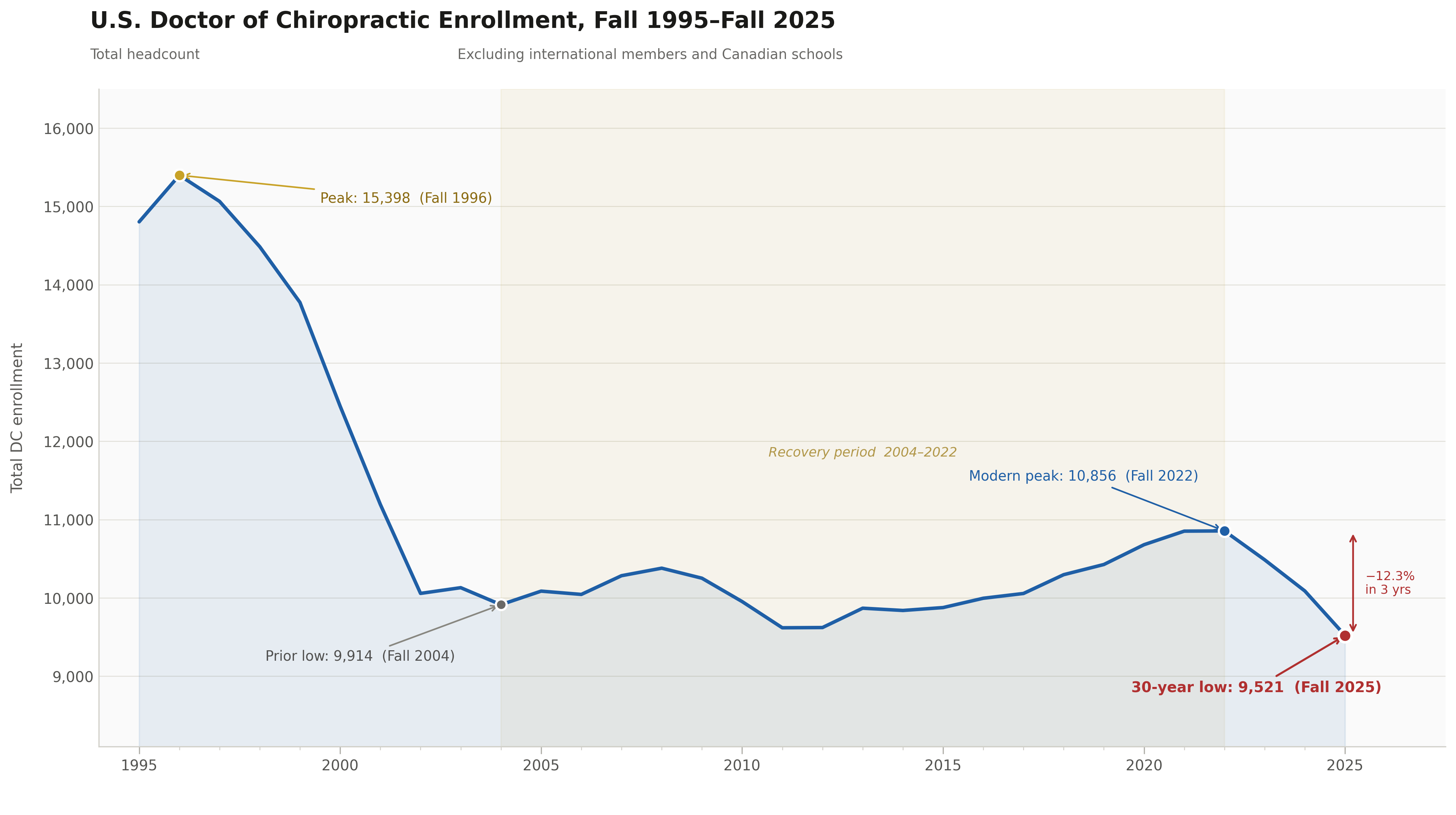
Enrollment was stronger. Federal student lending was expansive. Schools could tolerate administrative bloat, ill-conceived expansion, questionable investments and governance arrangements that would make an experienced nonprofit director wince. There was money moving through the system, and money can hide a multitude of institutional sins.
That environment is disappearing.
Chiropractic education is facing shrinking enrollment and significant student-finance pressure at the same time the profession’s regulatory architecture is changing. Life University and Life West have both bound students more tightly to NBCE examinations. CCE has voted to begin the process of withdrawing from continued U.S. Department of Education recognition while retaining its private CHEA recognition. The NBCE and FCLB relationship has been consolidated further. Students are being asked to absorb more institutional risk while the schools themselves have less margin for error.
Against that background, the spectacle of alumni and professional insiders rallying around leaders whose institutions are in obvious distress is maddening.
These people seem to believe they are protecting chiropractic but in reality they are protecting relationships and there is a difference.
When a friend has helped govern a school into financial trouble, the compassionate response is not to insist that everyone stop talking about the numbers.
When an independent investigator sustains allegations involving fiduciary conduct, friendship does not answer the report.
When an accreditor places an institution on probation, a selfie with the Board chair does not restore compliance.
When former students allege sexual assault and institutional indifference, the reputation of the accused among his friends is not dispositive of anything.
None of this should require explanation to professionals with doctoral degrees.
Yet here we are.
Chiropractic Has Developed a Loyalty Problem
The profession often speaks grandly about courage.
It is easy to be courageous in a room where everyone agrees with you.
It is considerably harder to tell a friend that he has become a liability to an institution you both love.
That is the courage chiropractic needs right now.
Instead, we have cultivated a culture in which belonging to the correct social circle provides a kind of informal immunity. Attend the same seminars, sit on the same boards, speak at the same conferences, belong to the same philosophical camp, and a remarkably large number of people will defend you before they have read a single document concerning what you are accused of doing.
This is how small professions rot from the inside.
It is not usually one grand conspiracy. It is hundreds of smaller accommodations. A conflict is excused because everyone knows each other. A questionable decision is tolerated because the person who made it has served chiropractic for thirty years. A board member overstays because nobody wants an unpleasant confrontation. An administrator is protected because removing him would look bad. A critic is attacked because discussing the facts publicly might damage the institution’s reputation.
Eventually the institution has nothing left but the reputation everyone was supposedly protecting.
Life West should recognize itself in that description.
Life University should too.
“Step Down, Get Out of the Way”
Stephanie Libs gave the Life West community a far healthier definition of loyalty.
She did not call for the college to be destroyed.
She called for people who are not upholding the institution’s ethics or their fiduciary responsibilities to leave leadership.
“Step down, get out of the way. Because the truth finds a way.”
That is not anger for anger’s sake.
It is organizational adulthood.
There is nothing sacred about a trustee’s seat. There is nothing sacred about a presidency. There is nothing sacred about being a dean, a professor, an association officer or a conference celebrity.
The institution is supposed to matter more.
Students are supposed to matter more.
The mission is supposed to matter more.
If the only argument for someone’s continued authority is that he has a large number of friends willing to pose beside him at a frat party, the argument has already failed.
If the Goal Were to Destroy These Schools, Silence Would Work Better
Critics of this reporting continue to question motive but that accusation becomes more absurd with every new document.
Someone who wanted Life West to collapse would not need to expose its governance failures. He could simply wait.
Let the Arizona property keep draining money. Let the leadership fights continue. Let accreditation problems compound. Let students learn about the sexual assault litigation from someone else.
Let the Board remain insulated until WSCUC, CCE, creditors or circumstances make the decisions everyone was too timid to make internally.
The same logic applies at Life University. Want it to fail? Ignore the covenant deterioration. Ignore the lawsuits. Ignore the governance structure. Ignore the retroactive academic policies. Ignore declining revenue while costs remain stubbornly high. Ignore the fact that the school has now moved through consecutive interim presidents while assuring everyone that a permanent search is progressing.
Silence is not loyalty when an institution is in trouble. Silence is how trouble matures into catastrophe.
Sunlight Is Still the Best Disinfectant
There is a version of this story in which Life West survives and emerges stronger.
There is a version in which Life University stabilizes its finances, breaks with entrenched governance habits, restores confidence and protects its students from being made the shock absorbers for institutional mistakes.
Neither version requires destroying the schools.
Both require disappointing some powerful people.
That is apparently the part everyone wants to avoid.
The chiropractic profession is at a sufficiently precarious point that we no longer have the luxury of maintaining leaders because removing them would make dinner awkward at the next convention. We cannot allow friendship networks to become shadow governance structures. We cannot permit legitimate philosophical loyalty to chiropractic to mutate into personal loyalty to individuals who happen to speak the right language about chiropractic.
The documents have to matter more than the relationships and the students have to matter more than the reputations.
And when a leader has failed an institution, whether through misconduct, incompetence or an inability to correct what happened on his watch, the answer cannot perpetually be another group photograph declaring solidarity.
Sometimes supporting a friend means standing beside him and sometimes supporting an institution means telling that friend to leave.
Life West has reached that moment.
So has Life University.
Stephanie Libs told the WAVE audience not to walk out on Life West, but to walk in and demand better. She was right.
The profession should do exactly that.
Read the reports. Read the financial statements. Read the lawsuits. Read the accreditation findings. Stop asking who is friends with whom long enough to consider what the evidence says.
Then decide what you are actually loyal to.
If the answer is chiropractic, act like it.
CLICK HERE for more on LIFE West
CLICK HERE for more on LIFE University
