1. The Master Controller: The Nervous System’s Central Role
The nervous system is the body’s master coordinator, responsible for every physiological process from the cellular level to complex cognitive function. As a Senior Neuro-Educator, I view this system as the foundational interface between an individual and their environment. Its primary responsibilities include:
Control: Directing both voluntary motor actions and involuntary autonomic processes.
Coordination: Synchronizing disparate organ systems to maintain homeostatic balance.
Signal Transmission: Managing the rapid, high-fidelity exchange of data between the brain and the peripheral body.
So What? Because the nervous system facilitates bidirectional communication between the brain and the body, any mechanical interference along its pathways can disrupt this vital flow, directly impairing the body’s innate ability to adapt, regulate, and heal.
Having established the nervous system’s essential role, we must examine the physical framework—the structural highway—that houses and facilitates this constant exchange of information.
2. The Communication Highway: Why Spinal Structure Matters
The relationship between the spine and the nervous system is the ultimate example of “structure governing function.” The spine acts as a protective conduit for the spinal cord, ensuring that the neural pathways remain patent. When this structure is compromised, the physiological result is a disruption of the body’s internal signaling.
Optimal Spinal Alignment
Structural Shifts (Subluxations)
Clear Signal Transmission: Nerve impulses travel between the brain and body with high-fidelity and zero resistance.
Obstruction: Physical misalignments can “choke” or attenuate nerve signal velocity and accuracy.
Proper Kinetic Motion: Joints move through their full range, promoting healthy fluid dynamics and tissue health.
Pathological Interference: Structural shifts disrupt the normal neuro-physiologic communication, leading to dysfunction.
Protective Integrity: The spine safely shields delicate neural tissues from external and internal stress.
Stress on Tissues: Misalignment creates abnormal mechanical tension on the dura mater, ligaments, and nerve roots.
When the structural integrity of this highway is compromised, we encounter a specific clinical phenomenon that serves as a primary “roadblock” to neurological health.
3. Defining Vertebral Subluxation: The “Structural Shift”
In a clinical curriculum, a Vertebral Subluxation is defined as a structural shift or dysfunction of the spinal joints that interferes with the normal transmission of nerve impulses. This is not merely a “bone out of place” but a complex pathological mechanism with three primary consequences:
Nerve Obstruction: A physical shift that creates mechanical pressure or tension on neural pathways.
Interference with Brain-Body Communication: A breakdown in the “feedback loop,” where the brain’s instructions and the body’s status reports are delayed or distorted.
Stress on Surrounding Tissues: Chronic misalignment leads to inflammatory responses and mechanical strain on the muscles and connective tissues surrounding the spine.
The Learner’s Primary Benefit: By identifying these subluxations, we shift our focus from “treating back pain” to “optimizing neurological regulation.” Correcting these shifts is the fundamental step in restoring the structural environment required for the nervous system to thrive.
4. A Real-World Illustration: Insights from the MS Case Study
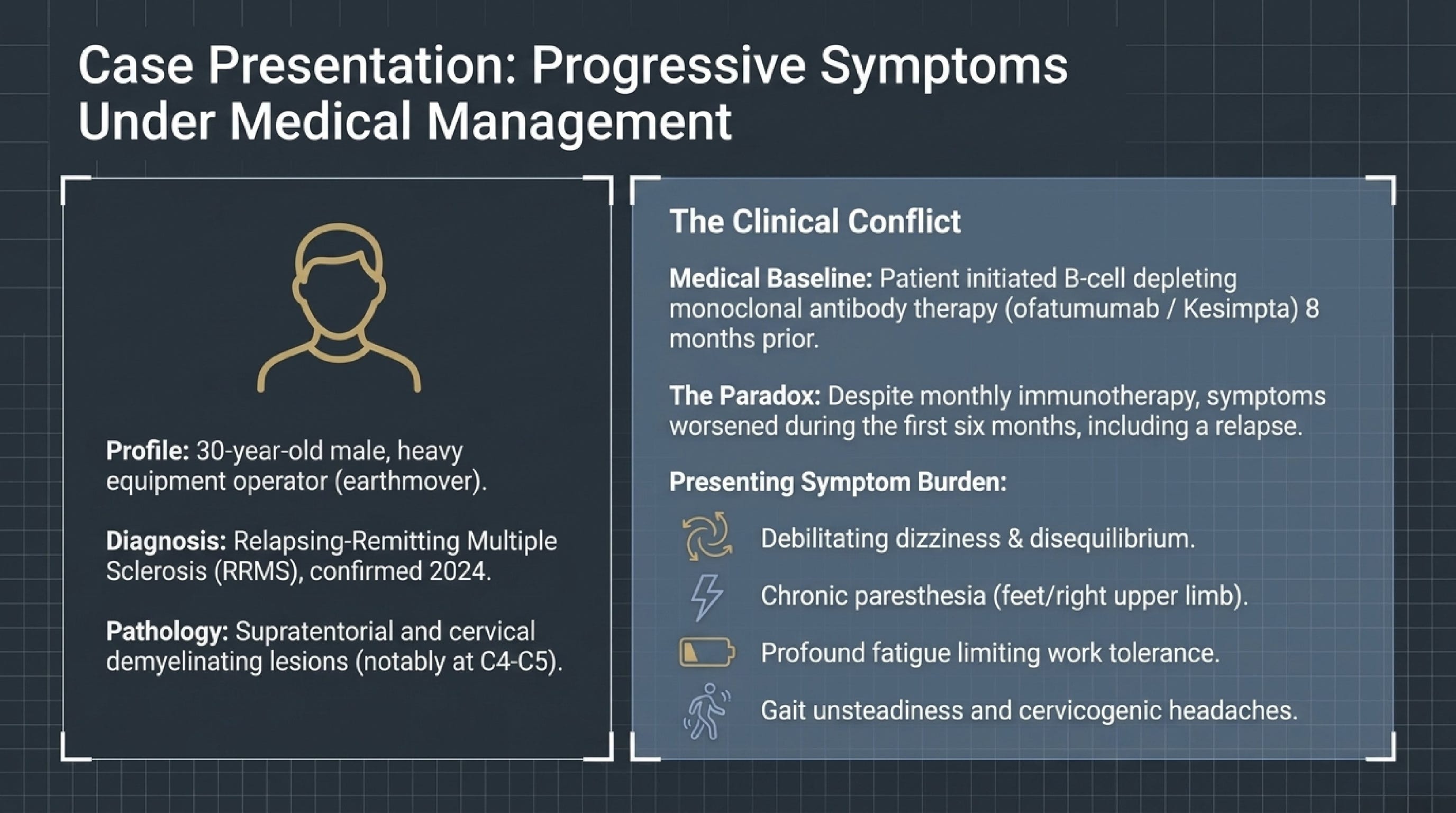
To understand the impact of these structural shifts on complex neurological conditions, consider a 30-year-old male diagnosed with Relapsing-Remitting Multiple Sclerosis (RRMS). Despite being on disease-modifying medical therapy (ofatumumab), he presented with significant neurological deficits:
Dizziness and Vertigo: Frequent episodes of disequilibrium and vertigo.
Fatigue: Profound exhaustion (MFIS score of 29) that limited work and daily activities.
Paresthesia: Chronic sensory numbness and tingling in the limbs and feet.
Gait Instability: Unsteadiness, especially on uneven surfaces.
Following the introduction of specific chiropractic care to address spinal subluxations, the patient experienced a 72.7% reduction in overall symptom burden (QVAS/OATS scores) and a 75.8% reduction in fatigue. Most notably, follow-up MRI imaging showed an objective reduction in T2 signal intensity at the C4–C5 lesion, indicating decreased inflammatory activity.
“Following the introduction of the Atlas Orthogonal (AO) technique and full-spine care, the patient reported a global impression of being ‘Very Much Improved.’ These improvements represent a significant shift in functional capacity and neuro-physiologic stability, complementing his ongoing medical regimen.”
5. The Mechanics of Restoration: How Adjustments Support Healing
The restoration of health in the case study was not accidental; it was driven by the correction of the Craniocervical Junction (CCJ)—the specific anatomical “choke point” where the skull meets the spine. Precise Atlas Orthogonal (AO) adjustments trigger three core mechanisms:
Cerebrospinal Fluid (CSF) Flow: Correcting alignment at the CCJ normalizes CSF pulsatility and reduces resistance at the foramen magnum. This optimizes the glymphatic system, enhancing the clearance of metabolic waste and inflammatory debris from the brain parenchyma.
Cerebral Venous Drainage: The position of the Atlas (C1) transverse processes is critical for the patency of the Internal Jugular Veins (IJVs) and the Vertebral Venous Plexus (VVP). Structural correction removes mechanical stenosis of these vessels, reducing venous congestion and improving intracranial compliance.
Neuro-Proprioceptive Integration: The CCJ is densely populated with mechanoreceptors. By restoring proper alignment, we normalize afferent signaling to the Vestibulocerebellar and Autonomic function centers, allowing the brain to recalibrate balance, coordination, and systemic regulation.
6. A Complementary Perspective: Support vs. Treatment
It is vital for the integrative wellness professional to distinguish between medical disease management and structural neurological support. While medicine may target the immune response, chiropractic care targets the structural integrity of the communication highway.
Chiropractic care is a complementary approach that optimizes the internal environment. It aims to:
Restore natural body coordination by ensuring the “Master Controller” is connected via a clear structural pathway.
Improve Intracranial Compliance by facilitating the free flow of fluids (blood and CSF) to and from the brain.
Facilitate Neuro-Proprioceptive Integration, ensuring the brain receives accurate data regarding the body’s position and state.
Support the body’s innate ability to self-regulate by removing structural subluxations.
7. Conclusion: The Vital Link Between Structure and Function
The clinical evidence confirms that the spine is not merely a framework for movement; it is the essential protector of our neurological communication network. When we maintain the structural integrity of the Craniocervical Junction and the broader spinal column, we ensure that the nervous system can coordinate life’s complex functions without mechanical interference.
Neurological health is fundamentally dependent on the seamless relationship between the structural alignment of the spine and the physiological function of the nervous system.
CLICK HERE for related research