
When the Debt Comes Due
What happens when a profession’s educational system is trapped inside a cartel that cannot innovate, cannot compete, and cannot tell students the truth about return on investment

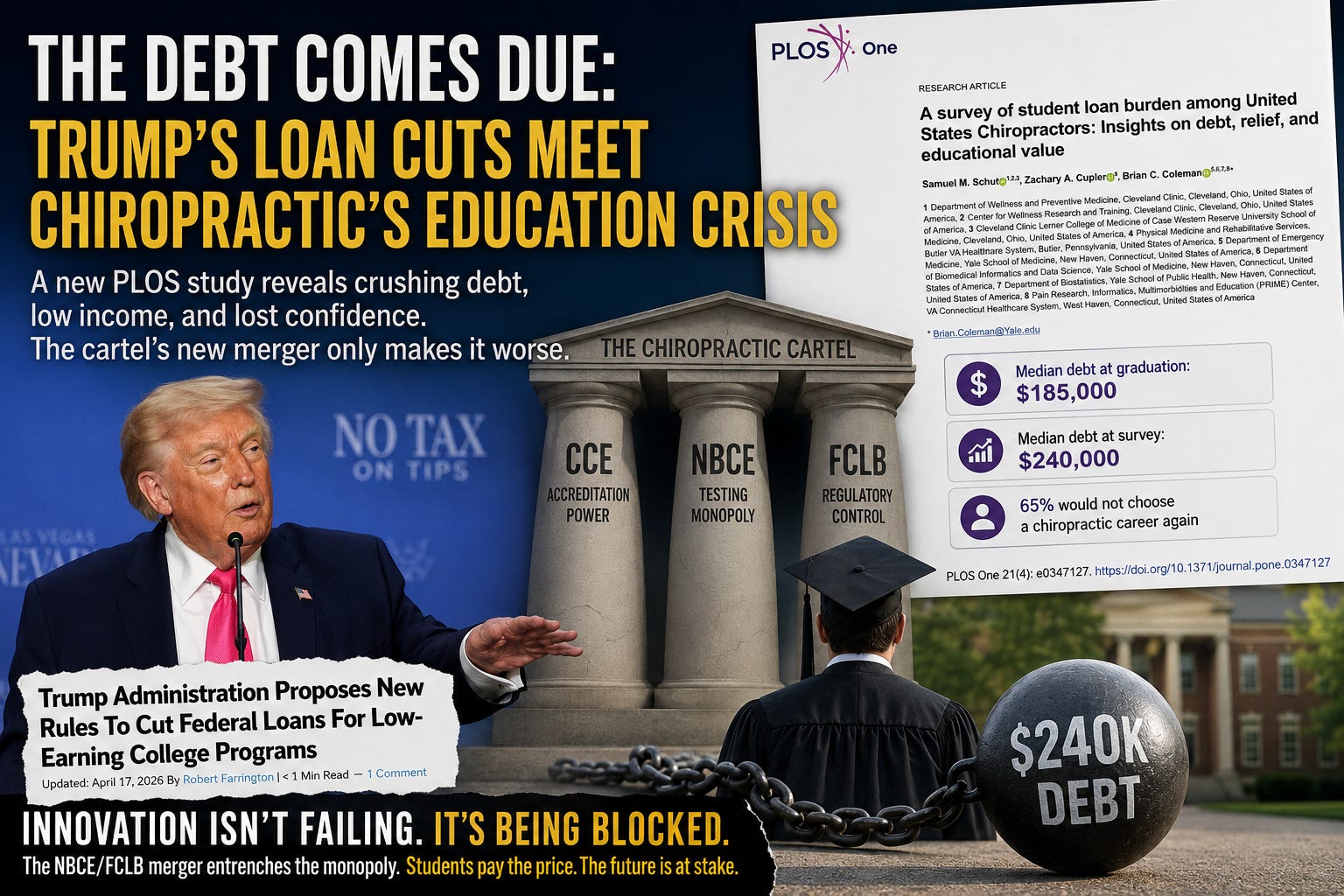
The crisis in chiropractic education is no longer theoretical. It is measurable in student debt, stagnant income, collapsing trust, and graduates who say they would not choose this profession again.
A new study published in PLOS One should be treated as a hair-on-fire event by every chiropractic college president, trustee, accreditor, regulator, and state association leader in the country.
The study, titled A survey of student loan burden among United States Chiropractors: Insights on debt, relief, and educational value, surveyed 1,455 chiropractors who graduated from U.S.-based, CCE-accredited Doctor of Chiropractic programs. The results are devastating. The median student loan debt at graduation was $185,000. At the time of the survey, 85% still had student loan debt, with a median balance of $240,000. Meanwhile, the median gross income reported for 2023 was only $76,000. More than half of respondents disagreed or strongly disagreed that their chiropractic education provided a positive return on investment. Approximately 70% rated the financial return on investment as low or very low. Most alarming of all, 65% said they would not choose a chiropractic career again.
That is not a messaging problem. That is not a branding problem. That is not something that can be solved with another slick admissions video, another white coat ceremony, another chiropractic leadership retreat, or another institutional claim about “student success.”
It is an existential warning.
The authors of the PLOS study concluded that chiropractors are burdened with substantial student loan debt that outpaces income, and that innovation is likely needed to support the sustainability of the chiropractic profession given the tension between educational debt and earnings.
The key word is innovation.
And that is precisely what the chiropractic cartel has spent decades preventing.
The Federal Government Is Moving Toward an Earnings Reckoning
The timing could not be worse for chiropractic schools.
A proposed Department of Education rule explains that the federal government is moving toward an earnings accountability framework for higher education programs. Under the proposal, programs would be judged by whether graduates earn enough, several years after completion, to justify continued access to federal student loans. Undergraduate programs would be compared to working adults with only a high school diploma, while graduate programs would be compared to bachelor’s degree holders and field-specific benchmarks. Programs that fail repeatedly could lose eligibility for federal Direct Loans for new students.
For chiropractic colleges, this should set off alarms in every president’s office and every boardroom.
The profession has long relied on federal student loan money to support a high-cost educational model, while graduates enter a marketplace where reimbursement is constrained, practice startup costs are high, managed care limits are real, and many doctors must build their own businesses immediately after graduation. The PLOS study now puts numbers to what graduates have been saying for years. The debt is too high. The income does not justify it. The value proposition is breaking down.
If federal policy begins asking whether chiropractic education produces an earnings premium, the profession cannot answer with slogans about passion, purpose, or philosophy. It will have to answer with data.
That data is now on the table. And it is brutal.
The Schools Are Trapped Inside the System That Is Failing Them
The deeper scandal is that chiropractic colleges are not free actors in a competitive educational marketplace. They operate inside a rigid private governance structure dominated by three interlocking entities: the Council on Chiropractic Education, the National Board of Chiropractic Examiners, and the Federation of Chiropractic Licensing Boards.
CCE controls accreditation. NBCE controls the exam pipeline. FCLB coordinates state regulatory boards, model laws, continuing education approval, and specialty recognition. In many states, statutes and regulations name CCE and NBCE directly, hardwiring private corporations into public law. CCE Policy 56 then ties institutional accreditation pressure to NBCE exam performance, making the private testing vendor not merely a licensure gatekeeper, but a survival metric for chiropractic schools.
College presidents should know that their institutions are not bystanders in this structure. Their students pay NBCE examination fees, those fees are included in cost-of-attendance calculations, and those costs are financed through federal student loans certified by the schools. The same advisory warned that graduates’ NBCE pass rates are the primary metric by which accreditation standing is measured under CCE Policy 56, even though NBCE materially altered Part IV through centralization without meaningful independent review by CCE.
That creates a trap.
Schools must satisfy CCE. CCE points to NBCE. NBCE changes the exam. State boards rely on NBCE. Students pay the bill. Federal loans fund the system. Graduates carry the debt. Then everyone acts surprised when a major peer-reviewed study shows that many graduates do not believe the investment was worth it.
Antitrust Is Not an Academic Theory Here
The inability to innovate in chiropractic education is not accidental. It is the predictable consequence of monopoly control.
In a functioning educational marketplace, schools could experiment with different models. They could create lower-cost pathways, competency-based education, practice-incubator models, hybrid clinical apprenticeships, shorter programs, new financing structures, alternative accreditation pathways, and licensure systems that recognize institutional clinical competency rather than forcing every graduate through a single private examination pipeline.
But chiropractic does not have that kind of marketplace.
It has a closed system where one accreditor dominates educational legitimacy, one testing corporation dominates licensure access, and one federation coordinates state regulatory adoption. The central concern: the NBCE/FCLB merger consolidates testing and regulatory infrastructure, while Part IV centralization accelerates the loss of state autonomy by giving one private entity greater control over the licensure pathway.
That is why the antitrust issue matters.
This is not merely about whether NBCE charges too much for exams, whether Part IV is inconvenient, or whether FCLB has become too dependent on NBCE funding. The larger question is whether private entities have used their interlocking control over accreditation, testing, licensure, continuing education, and regulatory coordination to restrain competition in chiropractic education and practice.
When the same private ecosystem controls accreditation pressure, examination access, regulatory coordination, and the metrics by which schools survive, innovation does not fail by accident. It is suffocated by design.
The PLOS study is what suffocation looks like after it reaches the graduate.
The NBCE/FCLB Merger Makes the Crisis Worse
The recent NBCE/FCLB merger does not solve any of this. It exacerbates it.
The merger takes two entities that were already structurally entangled and collapses them into a single consolidated power center. The post-merger structure places mandatory licensure examinations, state board regulatory coordination, continuing education approval through PACE, specialty recognition through RCSP, and ethics assessments through EBAS under one private organizational umbrella.
That is not modernization. It is concentration.
For students, it means the same system that has produced a poor debt-to-income reality becomes even harder to challenge. For schools, it means the same exam vendor whose outcomes influence accreditation pressure becomes even more intertwined with the regulatory machinery that state boards rely upon. For the profession, it means that any attempt to build alternative educational or practice models must pass through an even narrower gate.
This is the antitrust problem in practical terms. A chiropractor graduating with $240,000 in debt and a $76,000 median income is not merely the victim of tuition inflation. That graduate is the downstream casualty of a captured professional infrastructure that has failed to allow market correction.
Why Innovation Has Been Blocked
The PLOS authors politely call for solution-oriented collaboration to address affordability, quality, and value. That is appropriate for a peer-reviewed journal article. But the political reality is more severe.
Chiropractic education cannot innovate meaningfully while every school is forced to operate under the same accreditor, the same exam-based student achievement framework, the same licensure exam monopoly, and the same regulatory cartel that punishes deviation from its preferred model.
Schools that might want to reduce costs must still satisfy CCE. Schools that might want to shift toward different practice models must still answer to Policy 56. Schools that might want to assert that graduation from an accredited clinical program should be sufficient evidence of entry-level competency must still confront state laws and rules that lock in NBCE. Schools that might want to differentiate themselves philosophically, clinically, or economically face a system that rewards conformity and penalizes independence.
That is why the crisis is not simply financial. It is structural.
Chiropractic schools are being asked to rescue students from a debt crisis while remaining loyal to the very governance structure that helped create it.
If colleges respond to falling NBCE pass rates by making passage of all four NBCE exams a condition of graduation, the problem becomes even more dangerous. Such a policy collapses the distance between the institution and the contested mandate, because the school is no longer merely certifying costs arising from an external regulatory requirement. It is embedding the NBCE requirement into its own academic standards.
In plain terms, the school becomes the enforcer.
The Student Loan System Is the Cartel’s Oxygen Supply
The uncomfortable truth is that the chiropractic cartel is financed through students.
Students borrow federal money. Schools certify the cost of attendance. NBCE exam fees are folded into the educational cost structure. CCE accreditation preserves Title IV access. State boards mandate the exams. Graduates carry the debt. The profession then tells them that success is a matter of mindset, grit, hustle, and better marketing.
The PLOS study punctures that narrative.
When 65% of respondents say they would not choose chiropractic again, the profession has lost the right to dismiss this as negativity. When more than half do not believe their Doctor of Chiropractic program provided a positive return on investment, the schools have lost the right to hide behind mission statements. When 70% rate financial ROI as low or very low, trustees have a fiduciary obligation to ask whether their institutions are selling an educational product that the market can no longer sustain.
The new federal accountability framework raises the stakes further. If the government begins cutting off loan access to programs whose graduates do not achieve sufficient earnings outcomes, chiropractic colleges could find themselves facing the same question former students have been asking for years: what exactly were they sold?
The Schools Must Decide Who They Serve
Chiropractic colleges now face a defining choice.
They can continue appeasing the cartel, hoping that CCE, NBCE, and the merged NBCE/FCLB structure will somehow preserve the status quo long enough to avoid institutional reckoning. Or they can recognize that the status quo is the threat.
The PLOS study should force every chiropractic college to conduct an immediate and public review of tuition, total cost of attendance, student loan dependence, graduate income, practice readiness, NBCE-related costs, attrition, default risk, and borrower defense exposure. It should force CCE to reconsider whether Policy 56 has become a mechanism of institutional coercion rather than a valid measure of educational quality. It should force state boards to revisit statutes and rules that name private corporations instead of objective competency standards. It should force legislatures to ask whether chiropractic licensure has been improperly delegated to private actors with financial interests in the outcome.
Most importantly, it should force schools to ask whether they are preparing students for a viable future or feeding them into a debt machine.
The schools cannot claim to protect students while defending a system that leaves graduates indebted, disillusioned, and trapped in a market they were told would reward them.
The Fire Is Already Burning
There is still time to act, but not much.
The PLOS study is not an isolated data point. It is the smoke alarm. The proposed federal earnings accountability rule is the fire marshal arriving at the door. The NBCE/FCLB merger is gasoline poured on a system already under legal, financial, and moral stress.
If chiropractic colleges ignore this moment, they should not pretend they were not warned. The data is now published. The debt burden is documented. The ROI crisis is measurable. The federal policy environment is shifting. The cartel structure is being scrutinized. The merger has made the concentration problem worse.
The question is whether chiropractic education has the courage to break free from the system that is strangling it.
Because if the schools will not innovate, if they will not demand competition, if they will not defend students, and if they will not challenge the private monopolies that dictate their survival, then the market, the courts, the Department of Education, or the students themselves may eventually do it for them.

In my view, you are only scratching the surface to show the rot pervading Chiropractic education in North America.